What’s inside
Two pages, no clutter:
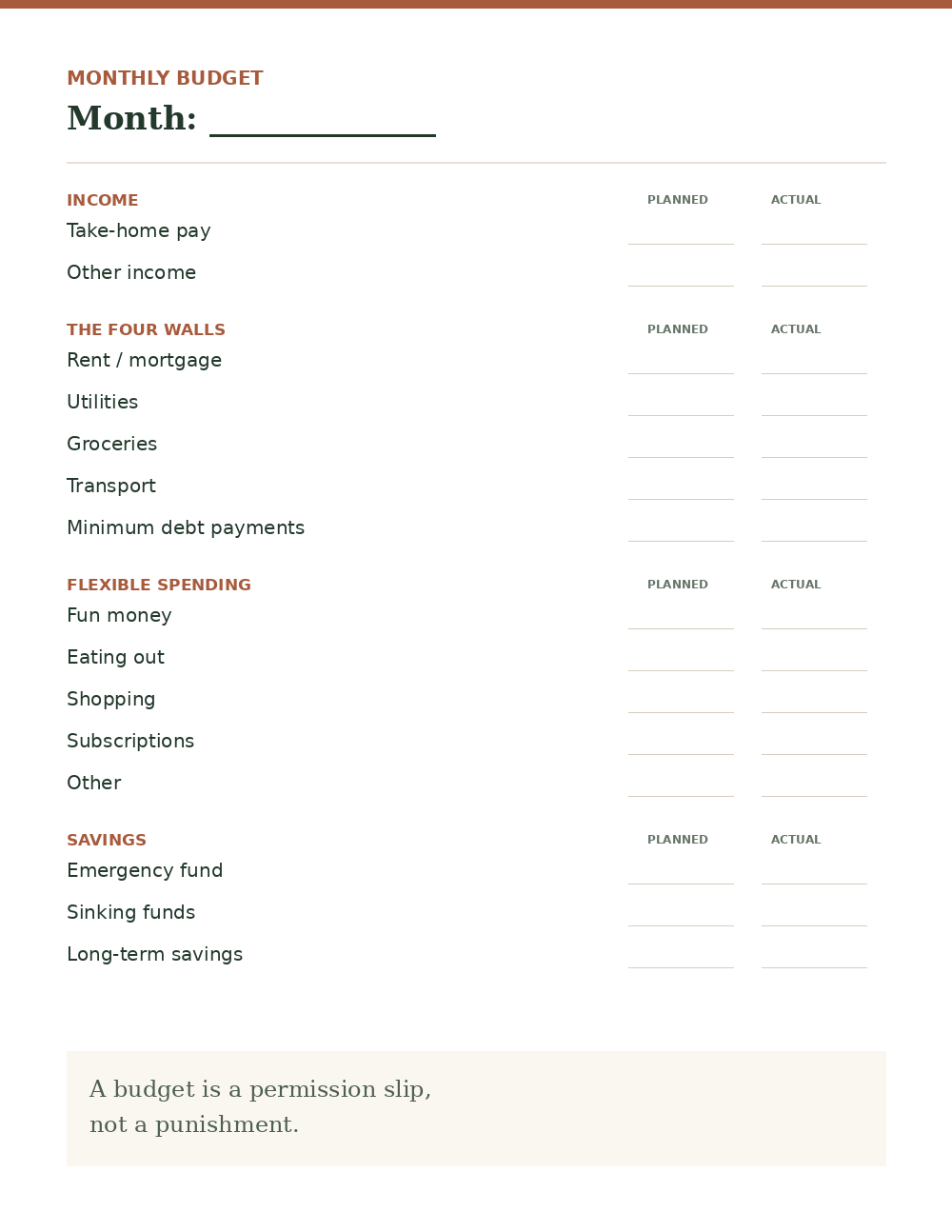
- Page 1: the monthly worksheet. Income at the top, then the four walls (rent and utilities, food, transport, minimum payments), then flexible spending, then the savings and sinking funds block. Every line has a space for the planned amount and the actual amount, so you can compare at the end of the month without opening a banking app.
- Page 2: the ten-minute setup checklist. The order to fill things in, the two automatic transfers to set up, and the one question to answer before you spend anything.
It is deliberately paper. A worksheet you can see on the fridge beats an app you open twice, and there is no login, no subscription, and nothing to cancel later.
How to use it in ten minutes
- Write your take-home pay, not your salary. The number that actually lands in the account.
- Fill the four walls first: rent and utilities, groceries, transport, minimum payments. These come before anything fun.
- Decide the savings number before the spending number. Whatever survives after the walls gets split, and the savings share is a fixed transfer on payday, not a leftover.
- Give the rest a job. Weekly spending, one guilt-free treat, and a small buffer for the thing you forgot.
- Write the actual numbers as the month goes. The gap between planned and actual is the whole lesson.
Start smaller than feels impressive
If a full month feels like too much on the first try, fill in only the four walls and the savings transfer. That is already most of the work, and it is more than most people do.
Printing it properly
Print at 100% scale on US Letter or A4, single-sided, black and white is fine. The layout has wide margins so it still looks right if your printer can’t print edge to edge. Print three copies for the next three months if you like the routine, or print one and reuse a pencil.
FAQ
Do I need to give you my email?
No. The download link goes straight to the PDF. The newsletter is a separate, optional thing, and it asks for confirmation before adding you.
Can I edit it on my phone?
It is a print-first worksheet, so it is designed to be filled in by hand or opened in any PDF app that supports annotation. It is not an Excel file, on purpose: no formulas means nothing breaks.
Is it US-specific?
The categories are generic (income, housing, food, transport, debt, savings) so it works anywhere. Only the sample figures in the blog posts are in US dollars, because that is who this site is written for.
Can I share it with a friend or my sister?
Yes, please do. Print as many copies as you want for personal use. Just don’t resell it or republish it as your own; the terms of use cover that in one line.
The posts behind it
If you want the reasoning before the worksheet, these three do the explaining:
- Your First Credit Card: What Builds a Score (and Wrecks It)
- The Benefits Form You Fill In During Week One
- How to Ask for More on Your First Offer
- How to Budget Your First Salary (Without Living Like a Monk)
- 10 Money Mistakes Every Fresh Grad Makes (So You Can Skip Them)
- Your Emergency Fund on an Entry-Level Salary: The Realistic Guide
Ready when you are
One PDF, two pages, no signup. Works on any printer.
Download the PDFEducational content only, not financial advice. Read the full disclaimer.